


- This event has passed.
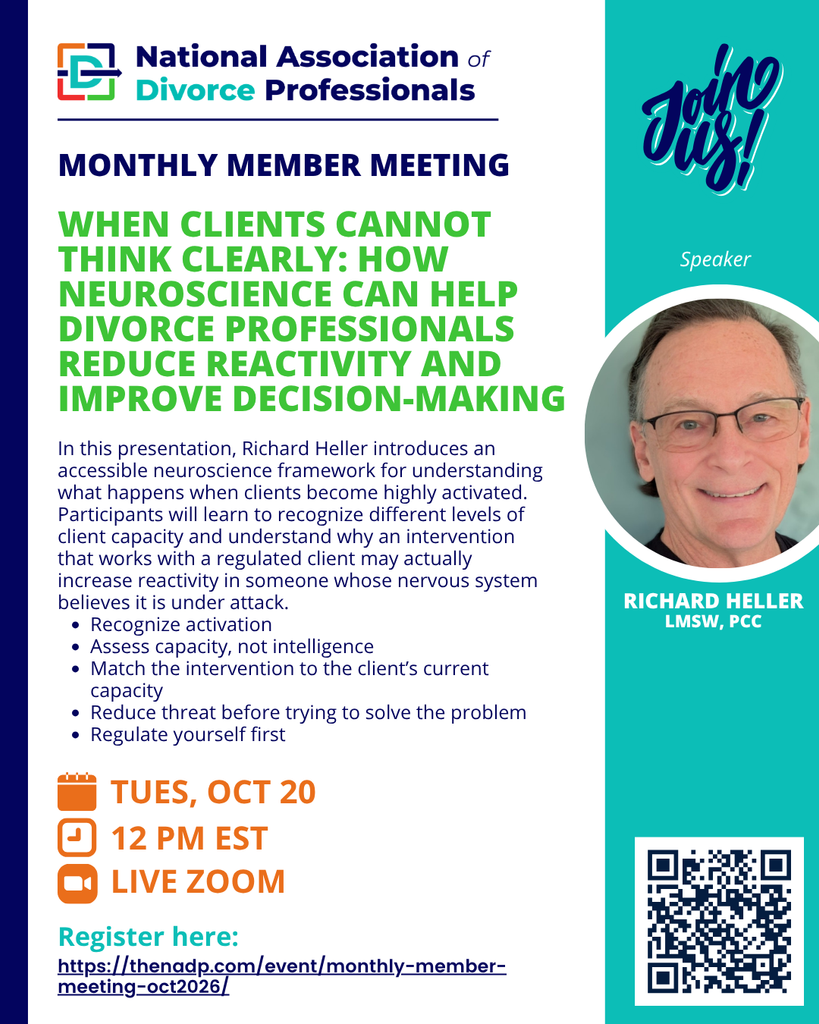
Monthly Member Meeting | When Clients Cannot Think Clearly: How Neuroscience Can Help Divorce Professionals Reduce Reactivity and Improve Decision-Making
October 20 @ 12:00 pm – 1:00 pm EST

High-conflict divorce can cause otherwise intelligent, capable people to make decisions that seem irrational, rigid, or self-defeating. They may repeatedly revisit settled issues, interpret neutral events as threats, or escalate conflict despite the obvious emotional and financial costs.
These behaviors are often viewed as communication problems, personality problems, or an unwillingness to compromise.
Neuroscience offers another explanation: chronic conflict can keep the nervous system in a state of threat, reducing access to the higher-order thinking required for flexibility, empathy, perspective-taking, and sound decision-making.
In this presentation, Richard Heller introduces an accessible neuroscience framework for understanding what happens when clients become highly activated. Participants will learn to recognize different levels of client capacity and understand why an intervention that works with a regulated client may actually increase reactivity in someone whose nervous system believes it is under attack.
Designed for attorneys, mediators, financial professionals, therapists, divorce coaches, and Parent Coordinators, the presentation also provides practical tools professionals can use immediately. Participants will learn how to recognize activation, match interventions to current capacity, move clients from positions toward underlying concerns, use committed listening to reduce threat, identify repetitive conflict patterns, and manage their own activation. The goal is not to turn divorce professionals into therapists—it is to help them create the conditions in which clients can think more clearly and make better decisions.
Key Takeaways:
- Recognize activation. Chronic conflict can change threat perception and temporarily reduce a client’s access to flexibility, empathy, curiosity, and perspective-taking.
- Assess capacity, not intelligence. A highly capable person may temporarily be unable to use the very reasoning skills they normally possess.
- Match the intervention to the client’s current capacity. Highly activated clients generally require more structure; as capacity increases, professionals can gradually return more responsibility for problem-solving and decision making.
- Reduce threat before trying to solve the problem. Naming activation, moving from positions to concerns, committed listening, and identifying repetitive patterns can help restore access to choice.
- Regulate yourself first. The professional’s own nervous-system state affects the interaction. A regulated professional is better able to reduce escalation and create the conditions for clearer decision-making.
Speaker Bio:
Richard Heller, LMSW, PCC, is a Parent Coordinator, mediator, professional coach, and founder of Bridge Builders Parent Coordination. His work focuses on helping families navigate high-conflict separation and divorce while reducing the impact of parental conflict on children. Drawing on more than 30 years of experience working with individuals, couples, and families, Rich integrates neuroscience, conflict resolution, and coaching to help people understand how nervous-system activation affects communication and decision-making. He also trains professionals to recognize reactivity, reduce escalation, and create conditions that support greater capacity, better decisions, and healthier outcomes for families.
**Guests are welcome to attend one Monthly Member Meeting. To attend again, we invite you to join our association**